Wednesday, August 17, 2022

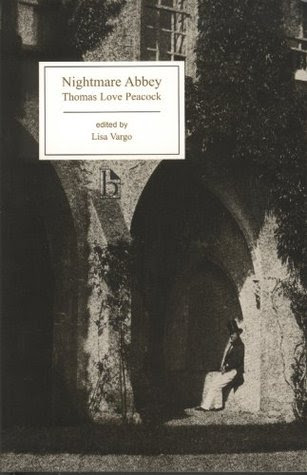
Nightmare Abbey by Thomas Love Peacock (novel #206)

...Mr. Glowry always chose [his domestics] by one of two criterions, - a long face, or a dismal name.


Nightmare Abbey is an exciting title, but for me, that is where the excitement began and ended. It is often categorized as gothic or horror. I assume these genre characterizations are inferred from the title, but no! It is neither! It is a satire of British romanticism.


Christopher Glowry – the first of many aptronyms in this novella – is a dour widower and lord of Nightmare Abbey, early 19th Century England. He lives with his son Scythrop, a pessimistic philosopher who, when not agonizing over his impotence to change the world, is confused and confounded by love for two different women.


Everyone in this story is ridiculous, which is certainly fair play for satire. The abbey hosts a parade of visitors participating in long, pointless debates. Most are of morose personality, presumably chosen to complement their host:  Mr. Listless, Mr. Toobad, Mr. Larynx, et al. Only Mr. Hilary, Glowry’s brother-in-law, presents a cheerful contrast.


As I write this, I realize the first aptronym is actually the abbey's name. It would have been a nightmare to spend an hour amongst its denizens.


I suppose Nightmare Abbey was successful as satire, but it hasn't aged very well. I found a few moments amusing, but most were lost on me. Many of the cast are caricatures of contemporary persons, some of them authors, presumably those Peakcock is satirizing. This character mapping had little meaning for me.


It’s a short, easy read. I’m glad to be moving on to the next book.


My rating:  3 out of 5 stars


This novel satisfies the category of a title containing a "Compound Word" in the What’s in a Name? 2022 challenge and “A Classic Set in a Place You’d Like to Visit” [England] category in the Back to the Classics 2022 Challenge

.

Thursday, August 11, 2022

The Last Unicorn by Peter S. Beagle (novel #205)

Appearing neither interested nor indifferent, but quiet in the way that a battlefield is sometimes quiet, she watched… [the Unicorn]


It’s a rare man who is taken for what he truly is. ~ Schmendrick the Magician


The Last Unicorn is a fantasy about exactly what the title states – though there is some question as to whether she is truly the last. The Unicorn overhears a hunter tell his companion that they are surely in a unicorn’s wood, as it has signs of enchantment. The hunter also expresses his belief, that if there is a unicorn in the woods, it is very likely the last of its kind.


Unicorns are ordinarily solitary and immortal. The Unicorn fears the others may be lost, captive, or in danger, so she leaves her beloved wood to discover the truth and save them if she can.


The Unicorn is aided along the way by Schmendrick an inept Magician, Molly Grue a gruff but kind woman, and eventually by the idler Prince Lir, who may hide a hero’s heart.


Beagle’s narrative has a lithe and whimsical tone that makes it a pleasure to read.


Beyond the town, darker than dark, King Haggard’s castle teetered like a lunatic on stilts, and beyond the castle the sea slid.


“Heroes,” Prince Lir replied sadly. “Heroes know about order, about happy endings – heroes know that some things are better than others.”


The reader grows to love the Unicorn and her friends, and dread the villain King Haggard and his evil hench-being, the Red Bull.


I liked The Last Unicorn very much, but it may have suffered from high expectations. There were two influences that contributed to my expectations: a charming introduction by Patrick Rothfuss and the song, The Last Unicorn performed by one of my favorite bands America. In spite of my unreasonable hopes, it is still a lovely little tale, with an unexpected and powerful ending that elevated it in the end.


My rating:  3.5 out of 5 stars


This novel satisfies the category of a title containing a "Mythical Being" in the What’s in a Name? 2022 challenge.


By the way, did you know that unicorns do not look simply like a horse with a horn?


She did not look anything like a horned horse, as unicorns are often pictured, being smaller and cloven-hoofed, and possessing that oldest, wildest grace that horses have never had, that deer have only in a shy, thin imitation and goats in dancing mockery. Her neck was long and slender, making her head seem smaller than it was, and the mane that fell almost to the middle of her back was as soft as dandelion fluff and as fine as cirrus. She had pointed ears and thin legs, with feathers of white hair at the ankles; and the long horn above her eyes shone and shivered with its own seashell light even in the deepest midnight.


The 1982 animated film is a very good rendition. Beagle wrote the screenplay so it is quite faithful to the book. The animation is superb (very 1982) and the cast of voice actors is star-studded: Jeff Bridges, Angela Lansbury, Alan Arkin, Christopher Lee, Keenan Wynn, et al, and Mia Farrow as the Unicorn.


 .

Saturday, August 6, 2022

Lion of Liberty: The Life and Times of Patrick Henry by Harlow Giles Unger

If this be treason, make the most of it. ~ Patrick Henry

While reading Thomas Jefferson: A Life, I realized a desire to read about Jefferson’s nemesis: Patrick Henry. Thomas Jefferson, the Revolution’s greatest writer, is a fascinating contrast with its greatest orator, Patrick Henry. Nemesis may be a bit strong, but I’ve read of no one else who could both astound and confound Thomas Jefferson, a man not easily affected in either extreme.


In contrast to Jefferson, the Tidewater aristocrat, Patrick Henry was a backwoods frontiersman – though classically educated. And in contrast to the ever deliberate and composed Jefferson, Patrick Henry let his passions blaze, though still quite deliberately and with amazing effect.


He was responsible for making the risks and hardships of the revolution popular with the common man, perhaps more so than any other individual.


First learning the art of persuasion as a criminal lawyer, Unger writes of Henry…


He left courtroom spectators stunned, breathless, helpless – in effect, captives.


He is best known for the famous line…” Give me liberty or give me death,” when addressing the Virginia convention in 1775.


But I found his most brilliant speech was ten years earlier, as a 29-year-old member of the Virginia House of Burgesses. He railed against the tyrannical Stamp Act. In summation, he declared…


Caesar had his Brutus, Charles the First his Cromwell, and George the Third…


***Dramatic pause for effect***


Met by cries of “Treason” by the Senior Burgesses before Henry continued, I must imagine with a mischievous sparkle in his eye…


George the Third,” he boomed in defiance, “may profit by their example! If this be treason, make the most of it!”


Thomas Jefferson would describe the moment…


I attended the debate…and heard the splendid display of Mr. Henry’s talents as a popular orator. They were great indeed; such as I have never heard from any other man…


George Mason would say of Henry…


He is by far the most powerful speaker I have ever heard.


Every word he says not only engages but commands the attention; and your passions are no longer your own when he addresses them. But his eloquence is the smallest part of his merit. He is in my opinion the first man upon this continent, as well in abilities and public virtues, and had he lived in Rome…Mr. Henry’s talents must have put him at the head of that glorious commonwealth.


At one point, in the debate over the Constitution, Henry’s oratory became a nearly supernatural legend; while expressing his most vehement passions in warning against the Constitution, the skies broke, and thunderclaps seemed to accentuate his every pause and point. Again, I imagine a sly grin as he made nature’s fury his own.


History has been a bit unkind to Patrick Henry for his opposition to the Constitution. He was a firm Anti-Federalist and envisioned a loose confederation of independent states. He feared the Constitution gave Congress tyrannical powers. He was also adamant that it sorely lacked a “Bill of Rights.” He proved insightful on that point, and I am not convinced his fears of almighty federal over-reach are not similarly justified.


During his day, and apart from George Washington, Patrick Henry was probably the nation’s most beloved founding father. He would likely have been the third president had he not declined the many calls for him to run. Despite his public declination, he finished fourth behind Jefferson, Adams, and Thomas Pinckney.


He was a devoted husband and father, with 15 children from 2 marriages. He kept a strict moral code, avoiding alcohol and gambling. He was a student of the Bible, saying…


This book is worth all the books that ever were printed.


Harlow Giles Unger’s work is a concise and compelling narrative. Concise, likely of necessity. In yet another contrast to Jefferson, Patrick Henry left few written records. Much of what is known of him is gleaned from the writings and memories of other founding fathers. And while he is neither perfect saint nor sinner, I now have a better understanding of and greater respect for the Lion of Liberty.


I’m going to claim lineage tracing to Patrick Henry. His daughter, Martha, married John Fontaine, a descendent of Huguenots, the de la Fontaines. Most of my clan have accepted further Anglicization to Fountain, but yeah…I’m apparently the great-great-great-great grandson or something like that of Patrick Henry

.
Tuesday, August 2, 2022

The Classics Club 10 Year Celebration Questionnaire

My responses to The Classics Club 10 Year Celebration Questionnaire.


When did you join the Classics Club?

May 2014. I’ve completed Round I and Round II lists and should finish Round III before the year ends.

What is the best classic book you've read for the club so far? Why?

A Tale of Two Cities by Charles Dickens. I’m a Dickens fan, and this is such a poignant example of sacrificial love. I’ve seen others rank Dickens’ novels, and they usually have either David Copperfield, Bleak House, or Great Expectations as #1. I like each of those, but for me, it is no contest; A Tale of Two Cities is #1.

What is the first classic you ever read?

To be very literal, and how can I be anything but in this venue?; I have to say The Cat in the Hat. But if we said “grown-up” classic, I believe it was The Lord of the Rings.

Which classic book inspired you the most?

Death Comes for the Archbishop

What is the most challenging Classic you've ever read or tried to read?

Ulysses. Close second: In Search of Lost Time. Both ugh!

Favorite movie adaptation of a classic:

The Lord of the Rings.  Close second: To Kill a Mockingbird

Least favorite movie adaptation:

Lord of the Flies, several attempts, all failed.

Which classic character most reminds you of yourself?

Tom Sawyer as a child. Sherlock Holmes as an adult, which sounds very presumptuous, but I am a puzzle solver professionally, just not as good as Sherlock. But who is?

Has there been a classic title you expected to dislike and ended up loving? Respecting? Appreciating?

I didn’t know what to expect and was intimidated by the Russian classics. But I found both The Brothers Karamazov and Anna Karenina accessible and enjoyable.

Classic you are definitely going to make happen next year?

Next year? As in 2023? Martin Chuzzlewit

Favorite memory with a classic and/or your favorite memory with The Classics Club?

Completing Round I and Round II, and anytime a club member comments on my blog.


.

Saturday, July 30, 2022

Invisible Cities by Italo Calvino (novel #204)

 (translated by William Weaver)


…seek and learn to recognize who and what, in the midst of the inferno, are not inferno, then make them endure, give them space. ~ fictional dialogue, Marco Polo to Kublai Khan


Invisible Cities is an unusual novel. It is a frame story wherein Marco Polo describes the diverse cities of the Mongol empire in an audience with Kublai Khan. It is part fantasy, as all the cities are imaginary with chimerical qualities.


In Perinthia’s streets and square today you encounter cripples, dwarfs, hunchbacks, obese men, bearded women. But the worse cannot be seen; guttural howls are heard from cellars and lofts, where families hide children with three heads or with six legs.


It is part poetry as the description of each is sensual and romantic.


The city displays one face to the traveler arriving overland and a different one to him who arrives by sea.


Cities, like dreams, are made of desires and fears, even if the thread of their discourse is secret, their rules are absurd, their perspectives deceitful, and everything conceals something else.


And I believe it is part commentary, perhaps on the invisible thread.


…there runs an invisible thread that binds one living being to another for a moment, then unravels, then is stretched again between moving points as it draws new and rapid patterns so that every second the unhappy city contains a happy city unaware of its own existence.


The 55 cities each bear a woman’s name and are grouped into one of eleven themes:

Cities & Memory

Cities & Desire

Cities & Signs

Thin Cities

Trading Cities

Cities & Eyes

Cities & Names

Cities & the Dead

Cities & Sky

Continuous Cities

Hidden Cities


At various intervals, there is a dialogue between the Khan and the explorer. Kublai senses his realm is in decline and is anxious to learn what he can from another’s senses. He is both curious and incredulous of Marco’s descriptions.


“This is what I wanted to hear from you: confess what you are smuggling: moods, states of grace, elegies!”


and


“There is still one [one city] of which you never speak.”

Marco Polo bowed his head.

“Venice,” the Khan said.

Marco smiled. “What else do you believe I have been talking to you about?”


It took a very silly turn when the two took a Turkish bath; the Khan blindfolded himself and then tried to locate Marco, by shouting “Marco,” to which Marco had to reply “Polo.”


Like my only other experience with Calvino, it is quite unconventional, but it didn’t captivate me the way If on a Winter’s Night a Traveler did. I suspect that Calvino’s message is philosophical and contemplative: mostly lost on me, though I admire his innovative approach and turn of phrase.


-- Just kidding about the Turkish bath, Marco Polo game :p --


My rating:  3.5 out of 5 stars


This novel satisfies "A Classic in Translation" [Italian to English] category in the Back to the Classics 2022 Challenge.


 Excerpt:


…I already know this would be the same as telling you nothing. The city does not consist of this, but of relationships between the measurements of its space and the events of its past: the height of a lamppost and the distance from the ground of a hanged usurper’s swaying feet; the line strung from the lamppost to the railing opposite and the festoons that decorate the course of the queen’s nuptial procession; the height of that railing and the leap of the adulterer who climbed over it at dawn; the tilt of a guttering and a cat’s progress along it as he slips into the same window; the firing range of a gunboat which has suddenly appeared beyond the cape and the bomb that destroys the guttering; the rips in the fish net and the three old men seated on the dock mending nets and telling each other for the hundredth time the story of the gunboat of the usurper, who some say was the queen’s illegitimate son, abandoned in his swaddling clothes there on the deck.


.


Saturday, July 23, 2022

Second Foundation (Foundation #3) by Isaac Asimov (novel #203)

A circle has no end ~ Arcadia Darrell

Second Foundation is the third book in the Foundation trilogy. There are subsequent prequels and sequels, but the trilogy stands complete.


Foundation (book #1) – Hari Seldon, the Galaxy’s preeminent psychohistorian, scientifically predicts the fall of the Galactic Empire and creates The Foundation to mitigate the ensuing chaos and suffering.


Foundation and Empire (book #2) – Seldon’s predictions prove accurate, and the benevolent intentions of the Foundation are confounded by the emergence of a mysterious conqueror known as the Mule. There are rumors of a Second Foundation at the far end of the Galaxy.


Second Foundation (book #3) – The Mule is rendered harmless, and The Foundation attempts to right the Galaxy and return to Seldon’s plan. However, members of The Foundation grow suspicious of The Second Foundation, never wholly convinced of its existence, and seem to work at cross purposes. It may be that hope of reconciliation and sparing the galaxy many millennia of suffering rests with Arcadia Darrell, the precocious granddaughter of Bayta Darrell, hero of book #2.


I found it riveting, filled with suspense, intrigue, human interest, and plenty of unexpected twists, especially in this concluding book. But I was a bit disappointed. I thought the suspicion The Foundation developed for The Second Foundation somewhat incongruous. They were ordinarily strict disciples of Seldon’s plan, and if The Second Foundation was part of the plan, it didn’t follow that they would attempt to subvert it. There is an explanation, but I thought it was weak and unconvincing.


Nevertheless, I enjoyed the trilogy. I’ll read more Sci-Fi by Asimov, but I don't think I'll read more in the Foundation series. The trilogy wrapped it up nicely, and I’ll leave it there.


My rating for book #3 and the trilogy as a whole: 3 ½ out of 5 stars


In my review of book #1, I mentioned that I believed the setting to be the distant future of Earth’s humanity, but that Asimov is never explicit on this point. In book # 3, there are some obvious clues that this is so. One character refers to another’s efforts as quixotic, a definite reference to Earth literature. The narrative also explains the standard time measure of the Galaxy as consisting of seconds, minutes, hours, and years based on the solar time of some planet lost in history.


For reason or reasons unknown to members of the Galaxy at the time of the era under discussion…


…before Man had spread beyond a single, now-unknown world.


And the synopses of other Foundation series books confirm Earth’s origin of the story.


.


Monday, July 18, 2022

Foundation and Empire (Foundation #2) by Isaac Asimov (novel #202)

…” intelligence”, “espionage,” and “spy stuff” are at best a sordid business of routine betrayal and bad faith. ~ Capt Han Pritcher


The opening quotation isn’t significant to the story, but it amuses me it as it applies to my day job.


In Foundation, Hari Seldon, the Galaxy’s preeminent psychohistorian, makes a startling prediction or scientific prophecy: the fall of the Galactic Empire and 30,000 years of chaos before a new galactic empire emerges. Shortly before his death, Seldon surreptitiously creates the Foundation, a consortium of his followers intent upon mitigating the 30,000 years down to 1,000 – a possibility under Seldon’s prediction.


In Foundation and Empire, the Galaxy is several hundred years into the interregnum. The Foundation has already survived several “Seldon Crisis,” an eventuality Seldon predicted would make the difference between 30,000 and 1,000. But an unforeseen threat emerges. An enigmatic and powerful conqueror known as The Mule subdues the crumbling remnants of the Empire, other independent worlds, and even the Foundation. This would seem to doom Seldon’s plans, but even as the Foundation crumbles, there is renewed hope. There are vague rumors of a Second Foundation at the far end of the Galaxy.


Hope to find the Second Empire seems to lie with an unlikely group: husband and wife team Toran and Bayta Darrell; prominent Foundation scientist Ibling Mis; and the Mule’s jester, Magnifico, who has defected to the custody of the Foundation trio, and who is particularly devoted to Bayta.


Like Foundation, the first in the trilogy, Foundation and Empire, ends abruptly and without closure. To find out how it all ends, I’ll take up the third book Second Foundation. The title can be confusing. Second Foundation is the third book in the trilogy: Foundation (#1), Foundation and Empire (#2), Second Foundation (#3). The title refers to the second mysterious Foundation hidden somewhere and presumably the last hope of defeating The Mule and reducing the interregnum from 30,000 to 1,000 years.


My rating is 3 ½ out of 5 stars


.