Showing posts with label poetry. Show all posts

Wednesday, December 22, 2021

Christmas Tales 2021

The Magi honored the Christ child with three gifts.


In honor of the magi, I read three Christmas tales each December. My Christmas reads are also part of A Literary Christmas – sponsored by In the Bookcase.


Papa Panov’s Special Christmas Day by Leo Tolstoy


A short story about Papa Panov, a village shoemaker somewhere in Imperial Russia. He seems a
simple man, in the best sense of the phrase, of modest means. He is a widower, and whatever children there were have long since left to make their own way. Papa Panov can still smile though at the sights and sounds of Christmas in his village. On Christmas Eve, he reads of the birth of Christ, and wishes he had been in Bethlehem to offer hospitality to Mary, Joseph, and the Son of God. He sleeps and dreams that Christ tells him he will visit Papa Panov on Christmas day.


Papa Panov awakes and awaits expectantly, but with a bit of doubt. It was only a dream after all. The only visitors are poor, and cold, and hungry. Papa Panov shares what he can to comfort the small stream of visitors. At days end as he prepares to retire for the night, he peacefully accepts…


it had been just a dream after all. Jesus had not come.


But there are a few lines left. They are not difficult to guess, but I’ll offer a hint from the Gospel of Matthew:


And the King shall answer and say unto them, Verily I say unto you, Inasmuch as ye have done it unto one of the least of these my brethren, ye have done it unto me. Matthew 25:40


A Christmas Inspiration by Lucy Maud Montgomery


A short story about a group of five young women – girls by most accounts – who, away from family in
a boarding house, share their Christmas treasures with one another in only slightly self-indulgent jollity. They remember the spinster, Miss Allen, whom they don’t really like, and who doesn’t really like them. They remember the postman, almost comical under his burden of gifts, and they remember that for Miss Allen there were no packages, no cards, no notice.


Jean, the unofficial leader of the group, has an inspiration, and the story turns foolishly maudlin, absurdly predictable, and blessedly beautiful!


The girls realize the “old truth, that it is more blessed to give than to receive. But this is so obvious, I would stand by my description of foolish and absurd, except the girls take the old truth and pledge to make it an “all-the-year-round inspiration.”
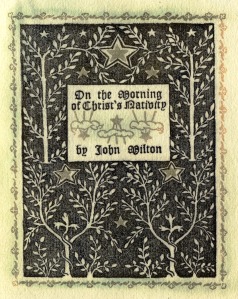


On the Morning of Christ’s Nativity by John Milton


An ode written by John Milton in 1629, one of his earliest poems, written when he was just 21, at
some time after Christmas. It contains a four-stanza proem (preamble – new word for me), and the main hymn of 27, 8-line stanzas. The hymn has four major themes:


Stanzas 1-12 – nature’s reaction to the advent of Christ.

I (excerpt)

It was the Winter wilde,

While the Heav'n-born-childe,

All meanly wrapt in the rude manger lies;

Nature in aw to him

Had doff't her gawdy trim,

With her great Master so to sympathize:


Stanzas: 13-18 anticipates Christ’s redemption of humanity.

XVI (excerpt)

The Babe lies yet in smiling Infancy,

That on the bitter cross

Must redeem our loss;

So both himself and us to glorifie:


Stanzas 19-26 depicting Christ’s expulsion or silencing of pagan dieties.

XIX (in entirety)

The Oracles are dumm,

No voice or hideous humm

Runs through the arched roof in words deceiving.

Apollo from his shrine

Can no more divine,

With hollow shreik the steep of Delphos leaving.

No nightly trance, or breathed spell,

Inspire's the pale-ey'd Priest from the prophetic cell.


The final stanza, 27 – the nativity scene itself.

XXVII (excerpt)

But see the Virgin blest,

Hath laid her Babe to rest.

Time is our tedious Song should here have ending,


It was beautiful, clearly a work of passion and devotion. I’ve not read Milton before, and this was an amazing introduction. I may take on Paradise Lost in the New Year.


The Early Modern English is a bit challenging. It was much more accessible with scholarly introduction and commentary, such as: The John Milton Reading Room


Merry Christmas


          ~ The Wanderer


May you be blessed with

the spirit of the season, which is Peace,

the gladness of the season, which is Hope, 

and the heart of the season, which is Love


.

Saturday, April 4, 2020

Rudyard Kipling: Selected Poems

Rudyard Kipling: Selected Poems


Rudyard Kipling is perhaps best known for The Jungle Book, but he was also a prolific poet, writing over 500 poems. Some of his most beloved and best known are included in Selected Poems, such as: If, The White Man’s Burden, Gunga Din, and The Law of the Jungle.

I am not a serious student of poetry, but as a layman, I can say his poetry is at times fun, at others poignant, at others bitter-sweet, and at others rather bewildering. Kipling was certainly not bound to any particular meter or form. Some of his poems were quite easy to read, with a pleasing rhythm, and others were quite complex, with unusual meter, and for me, somewhat less enjoyable. 

I think T.S. Eliot put it very adeptly. He says Kipling was
…a writer impossible to wholly understand and quite impossible to belittle
Or another poet, Alison Brackenbury put it
Kipling is poetry's Dickens…

By today’s standards he was a shameless imperialist, as seemingly revealed in The White Man’s Burden, when he refers to
          Your new-caught sullen peoples, 
          Half devil and half child

But it is difficult to know when Kipling is being arrogant and when he is being ironic – a point debated even among scholars.

If you care for this reader’s unscholarly opinion: I think a little of both. Kipling was a British Imperialist, there is no doubt
Excerpt from The English Flag

          What is the Flag of England? Ye have but my reefs to dare,
          Ye have but my seas to furrow. Go forth for it is there!

But I think he also saw cost, and sin, and shame in it, and used his art to lament and to glory.
Such as in The Settler, which is about living in peace after war (British settler in South Africa after the war)

          And when we bring old fights to mind,
          We will not remember the sin – 
          If there be blood on his head of my kind,
          Or blood on my head of his kin

So back to his art – the man could write.

I particularly liked The Law of the Jungle, which to be more precise is the Wolf Pack law

          As the creeper that girdles the tree-trunk
          the Law runneth forward and back – 
          for the strength of the Pack is the Wolf
          and the strength of the Wolf is the Pack

(stanzas later)
          Ye may kill for yourselves, and your mates, and your cubs
          as they need, and ye can;
          But kill not for pleasure of killing,
          and seven times never kill Man!

But my favorite was If – a father’s advice to his son

          If you can dream – and not make dreams your master;
          If you can think – and not make thoughts your aim;
          If you can meet with Triumph and Disaster
          And treat those two impostors just the same;

(concluding stanza)
          If you can fill the unforgiving minute
          With sixty seconds’ worth of distance run,
          Yours is the Earth and everything that’s in it,
          And – which is more – you’ll be a Man, my son!

Other poems I liked:
The Young British Soldier

When Earth’s Last Picture is Painted (about how artists will employ their craft in Paradise)

Pussy Can Sit by the Fire and Sing (the virtues of dog vs cat)

Dirge of Dead Sisters (a tribute to nurses who died in the South African War)

The Benefactors (ironically named, recounts the tale of how man’s weapons have “progressed” thru the ages.)

Quite fittingly, and cited in entirety, The Appeal is the final poem of this collection:

         The Appeal
          If I have given you delight
          By aught that I have done,
          Let me lie quiet in that night
          Which shall be yours anon:

          And for the little, little span
          The dead are borne in mind,
          Seek not to question other than
          The books I leave behind.

This collection satisfies square G-3, Poetry or Essay Collection, in the 2020 Classic BINGO Challenge

Monday, December 10, 2018

The Early Poems of Alfred Lord Tennyson

The Early Poems of Alfred Lord Tennyson 


I’ll begin with an excerpt…taken from To The Queen, shortly after Queen Victoria made Tennyson Poet Laureate of Great Britain and Ireland.
     To the Queen (excerpt)
     Her court was pure; her life serene;
     God gave her peace; her land reposed;
     A thousand claims to reverence closed
     In her as Mother, Wife and Queen
The Early Poems is a collection of 137 of Tennyson’s poems. And even though I write a little poetry, I’m not much of a fan of reading it. But, I intended to stretch myself with this read, and in that at least I was successful. Much of Tennyson’s poetry is quite honestly over my head. The language is so esoteric, I grasped little of what the poet was attempting to express. Take this title for example: The lintwhite and the throstlecock

Does that speak to you? Me either. In many of these poems, if I strained too hard to understand the meaning, I missed the beauty of the meter and rhyme. If I listened to the beauty, I missed the meaning. However, I am inclined to believe that reading poetry is a skill like any other – one that must be developed and exercised. I do think, that by the end, I was comprehending a bit more, and so – my poetry education is only beginning.

Tennyson treats a wide range of topics poetically. Two poems that came back-to-back: The Grasshopper, and Love Pride and Forgetfulness. At other times, he writes in series. For instance, he wrote Nothing Will Die, and then followed with All Things Will Die in an identical meter. I thought those were clever. He also put to poetry other works of literature or legend, such as the plays of Shakespeare, Mort d’Arthur, or the legend of Lady Godiva.

And though much was over my head, there was a good deal, that I did comprehend, and a good deal that I appreciated. Some excerpts from some of those I did admire.

The Palace of Art (in which Tennyson gives a nod to some other pretty decent poets)
     For there was Milton like a seraph strong,
     Beside him Shakespeare bland and mild;
     And there the world-worn Dante grasp’d his song,
     And somewhat grimly smiled.

The May Queen – tells of a vain and selfish young woman. And then in a sequel…

Conclusion (the same girl is dying, but has learned virtue and humility)
     Nor would I now be well, mother, again, if that could be,
     For my desire is but to pass to Him that died for me.

To J.S. (to console a friend whose brother had died)
     I have not look’d upon you nigh,
     Since that dear soul hath fall’n asleep
     Great Nature is more wise than I:
     I will not tell you not to weep.

You ask me, why, tho’ ill at ease (speaking of his revered England)
     It is the land that freemen till,
     That sober-suited Freedom chose,
     The land, where girt with friends or foes
     A man may speak the thing he will;

Mort d’Arthur
     Pray for my soul. More things are wrought by prayer
     Than this world dreams of…

The Talking Oak (I think perhaps, Tolkien borrowed this to contrive his Ents)
     For ah! My friend, the days were brief
     Whereof the poets talk,
     When that, which breathes within the leaf,
     Could slip its bark and walk.

The Golden Year
     But we grow old! Ah! When shall all men’s good
     Be each man’s rule, and universal Peace
     Lie like a shaft of light across the land,
     And like a lane of beams athwart the sea,

Ulysses
     I am a part of all that I have met

Will Waterproof’s Lyrical Monologue
     For I had hope, by something rare,
     To prove myself a poet;
     But, while I plan and plan, my hair
     Is gray before I know it.

And my favorite of all was a poem called Two Voices – which is autobiographical. The two voices, tell of the inner conflict and thoughts of suicide Tennyson had after the death of a dear friend.

     Then to the still small voice I said;
     “Let me not cast in endless shade
     What is so wonderfully made”.

And later refuting the suicidal voice

     “These words,” I said, “are like the rest,
     No certain clearness, but at best
     A vague suspicion of the breast:

And still later, when he hears the Sunday bells tolling, and watches a young family on their way to worship..

     I blest them, and they wander’d on:
     I spoke, but answer came there none:
     The dull and bitter voice was gone.

And near the end…
     A second voice was at mine ear,
     A little whisper silver-clear,
     A murmer, “Be of better cheer”.

.

Saturday, April 14, 2018

The Poetry of William Shakespeare (April is Poetry Month)

The play’s the thing – unless of course you are reading Shakespeare’s poetry

And since April is Poetry Month, I thought it a good time to finish off the rest of Shakespeare’s poetry. The rest – meaning everything besides The Sonnets, which I previously commented on HERE.

That leaves two lengthy poems, a mid-length poem, and a number of shorter works.


Venus and Adonis – (199 x six line stanzas, or 1194 lines)
The tale of the goddess Venus and her tragic love for beautiful young Adonis. For all her legendary beauty and charm, Venus cannot win the love of Adonis who just wants to go hunting.

O what a war of looks was then between them!
Her eyes, petitioners to his eyes suing;
His eyes saw her eyes as they had not seen them
Her eyes woo’d still, his eyes disdain’d the wooing 

When Adonis is killed on the hunt, Venus despairs and curses love forever to be marked by sorrow and pain.


The Rape of Lucrece – (265 x seven line stanzas, or 1855 lines)

You can probably infer the subject. Lucrece is the beautiful and virtuous wife of Roman soldier Collatine, who makes the mistake of bragging of her beauty to Tarquin, a fellow soldier. Tarquin must see for himself, and when he does, tragically – the die is cast. Once the deed is done, Tarquin flees.

He thence departs a heavy convertite;
She there remains a hopeless castaway;
He in his speed looks for the morning light;
She prays she never may behold the day; …

Tarquin flees, Lucrece sends for Collatine, and vows…

‘Yet die I will not till my Collatine
Have heard the cause of my untimely death;
That he may vow, in that sad hour of mine,
Revenge on him that made me stop my breath.
My stained blood to Tarquin I’ll bequeath
Which by him tainted shall for him be spent,
And as his due writ in my testament.


A Lover’s Complaint – (47 x seven line stanzas, or 329 lines)

The tragic tale of a young maid, who yields to a charming seducer, who abandons her shortly after having his way. A kindly older gentleman sees her despair and inquires; she tells of how artfully she was seduced.

‘But woe is me! Too early I attended
A youthful suit (it was to gain my grace)
Of one by nature’s outwards so commended
That maiden’s eyes struck over all his face;
Love lack’d a dwelling, and made him her place;

And yet, she also admits, she would yield again.

‘O, that infected moisture of his eye,
O, that false fire which in his cheek so glow’d
O, that forc’d thunder from his heart did fly,
O, that sad breath his spongy lungs bestow’d
O, all that borrow’d motion, seeming ow’d
Would yet again betray the fore-betray’d
And new pervert a reconciled maid!’


The Passionate Pilgrim – (collection of 20 short poems, most of which are now considered not genuinely Shakespeare, but still published under this collective title.


Sonnets to Sundry Notes of Music – (six miscellaneous sonnets, distinct from The Sonnets)

He that is thy friend indeed,
He will help thee in thy need
If thou sorrow he will weep;
If thou wake, he cannot sleep;
Thus of every grief in heart
He with thee doth bear a part
These are certain signs to know
Faithful friend from flattering foe


The Phoenix and the Turtle

The name is a bit of a misnomer; it about the Phoenix and the Turtledove – representing perfection and love, or in combination perfect love. 

Yay! finally a cheerful poem, yes?

No. The poem is about their funeral, attended by other birds of various symbolism. 


Not surprising, Shakespeare’s poetry is rather morose. Hence, I cannot say I enjoyed any of it, but I certainly admired the works. The longer poems in particular – to keep the meter, pattern, rhyme, and rhythm, and also tell a cohesive tale – is truly remarkable.
.