Showing posts with label short story. Show all posts

Sunday, March 1, 2026

The Adventure of The Beryl Coronet: a Sherlock Holmes short story by Arthur Conan Doyle

"The Adventure of the Beryl Coronet”1 is the twelfth and final short story in The Adventures of Sherlock Holmes collection. According to The Annotated Sherlock Holmes2, it was Holmes’ 30th case chronologically.

Dr. Watson, looking out the window one winter morning, observes a well dressed madman excitedly winding his way down Baker Street (nod to Gerry Rafferty). The madman is a prominent London banker, frantically searching for 221B and the residence of Sherlock Holmes.

The beryl coronet, one of Britain’s public treasures, has been stolen, partially recovered, but missing three of the valuable jewels. The police and banker have the culprit, the banker’s son, but he is uncooperative regarding the missing pieces. In customary fashion, Holmes is unimpressed with official police narrative and the game is afoot.

I was a bit disappointed. There was none of the collegial banter between Holmes and Watson, no snide remarks on police competence, no great suspense, and the characters were not very memorable. Holmes did at least go incognito for some nighttime sleuthing, but even that was one of his more pedestrian disguises. The mystery was good, but  the other aspects of the story, just so-so.


1 A note about titles: When first published serially, many Sherlock Holmes short stories did not include the noun phrase “The Adventure of” as part of the title. The noun phrase was only added later, in most cases, when the short stories were compiled into one of five collections: The Adventures of Sherlock Holmes; The Memoirs of Sherlock Holmes, The Return of Sherlock Holmes, His Last Bow: Some Later Reminiscences of Sherlock Holms; and The Case Book of Sherlock Holmes. This short story was originally titled The Beryl Coronet, and later changed to The Adventure of the Beryl Coronet when it was published as part of The Adventures of Sherlock Holmes.

2 The Annotated Sherlock Holmes attempts to put all of Sherlock Holmes’ cases into their proper, fictional, chronological order.


Sunday, January 18, 2026

The Adventure of Silver Blaze: a Sherlock Holmes short story by Arthur Conan Doyle

"The Adventure of Silver Blaze”1 is a Sherlock Holmes short story from The Memoirs of Sherlock Holmes collection. According to The Annotated Sherlock Holmes2, it was Holmes’ 29th case chronologically.

Silver Blaze is the favorite in the upcoming Wessex Cup. Just a week before the race, the horse comes up missing, and his trainer is brutally murdered. Silver Blaze, depicted here by Holmes illustrator Sydney Padget, is a fictional horse, sired by the real-life champion Isonomy.

One of my favorite parts is how Holmes gets Watson to assist him. Watson observes Holmes thinking, pacing, stewing for several days, when Holmes announces he is leaving to pursue a case. Watson volunteers…

I should be most happy to go down with you if I should not be in the way

And Holmes replies…

My dear Watson, you would confer a great favour upon me by coming. And I think that your time will not be mis-spent.

This sort of thing is becoming cliché between them. Holmes does not want to ask outright, but instead tempts Watson into volunteering. Once that is achieved, Holmes is gracious and happy to have Watson’s assistance. But I think Holmes is happy just to have Watson’s companionship. There is a heart in Sherlock Holmes.

Another bit that made me smile: Holmes is explaining that the case is somewhat muddled:

The tragedy has been so uncommon, so complete, and of such personal importance to so many people that we are suffering from a plethora of surmise, conjecture, and hypothesis.

As a word-nerd I loved this, because Holmes used “plethora” correctly. Of course he did; he’s Sherlock Holmes. But it is often misused. It does not simply mean a lot; no, it means a lot of something unwanted, but that is not quite precise yet. It means an OVER-abundance of something that would ordinarily be good but that in excessive quantities is undesirable. It is from the medical term “plethoric” where there are too many white blood cells. White blood cells are good, but too many of them can be fatal. Sorry to school, but it’s a pet peeve of mine, and it made me happy when Holmes used it so perfectly.

The mystery? I’m won’t spoil it. It was very good, with a most unusual culprit. The last couple Holmes’ adventures I’ve read were not great, so it was nice to read of Holmes back up to snuff. 


1 A note about titles: When first published serially, many Sherlock Holmes short stories did not include the noun phrase “The Adventure of” as part of the title. It was only added later, in most cases, when the short stories were compiled into one of five collections: The Adventures of Sherlock Holmes; The Memoirs of Sherlock Holmes, The Return of Sherlock Holmes, His Last Bow: Some Later Reminiscences of Sherlock Holms; and The Case Book of Sherlock Holmes. This short story was originally titled Silver Blaze, and later changed to "The Adventure of Silver Blaze" when it was published as part of The Memoirs of Sherlock Holmes.

2 The Annotated Sherlock Holmes attempts to put all of Sherlock Holmes’ cases into their proper, fictional, chronological order.


Sunday, August 31, 2025

The Adventure of Wisteria Lodge: a Sherlock Holmes short story

"The Adventure of Wisteria Lodge” is a Sherlock Holmes short story from The Sherlock Holmes collection His Last Bow. According to The Annotated Sherlock Holmes, it was Holmes’ 28th case chronologically.

A respectable British gentleman, Mr. Eccles, employs Holmes to discover the meaning of an unusual encounter. Eccles was visiting the home of a new acquaintance and as arranged in advance spent the night. In the morning the house was abandoned without a trace by the master and all servants. Shortly after Eccles begins to recount the evening, the police arrive to question him. His acquaintance was found dead that morning and a note on the deceased revealed the previous evening’s plans, leading them to Holmes’ client.


From there, the police follow one theory, while Holmes follows his own. In spite of this divergence, Holmes notes, with rare admiration, the powers of observation of Inspector Baynes, a new Holmes character.


And for once, the police are not utterly inept. Baynes is surreptitiously on the same scent as Holmes, but uses a false public investigation as misdirection to lull the real culprit into a false sense of security.


And the game is afoot.


Dr. Watson is not very enthusiastic about the case.

But there was something in the ice-cold reasoning of Holmes which made it impossible to shrink from any adventure which he might recommend. One knew that thus, and only thus, could a solution be found. I clasped his hand in silence, and the die was cast. 

And for those of you counting, that makes two allusions to Shakespeare! 


It is a fun adventure with creepy specters, bizarre clues, and still more misdirection. And as I’ve hinted, a very rare occurrence in the Sherlock Holmes canon: a police detective very nearly the equal of the great Sherlock Holmes.


Sunday, July 13, 2025

They Shoot Canoes Don’t They? by Patrick F. McManus

This is a collection of humorous short stories by Patrick McManus that originally appeared in Outdoor Life and Field and Stream magazines. All of McManus’ stories revolve around his outdoor misadventures – mostly hunting and fishing.


This particular volume includes the first story I ever read by McManus, the title story: "They Shoot Canoes Don’t They?" I read it in a doctor's waiting room, and I’ve been hooked ever since. One of very few authors who can actually make me laugh out loud.


The stories are droll and self-effacing, and although they are preposterous, I get the distinct impression many might just be based on actual events, albeit wildly embellished – perfectly appropriate for any sportsman yarn-spinner.


They are also marvelously relatable and often reminiscent to any outdoorsman.


In one story, "The Fishing Lesson", McManus reminisces...


Over the years, I’ve introduced several dozen people to the pleasures of outdoor sports. So what that some of them didn’t want to be introduced!


Yep, been there, done that.


They might otherwise have ended up as criminals or drug addicts or golfers. I like to think I’ve had some small part in saving them from such dismal fates.


This is the third collection published of at least 14. There are numerous recurring characters: Ma and Gramms, sister known affectionately as The Troll, dog Strange. There is his novice outdoorsman neighbor Al Finley and hunting and fishing companion Retch Sweeney. My favorite: the curmudgeonly mountain man and mentor from Patrick’s youth Rancid Crabtree (Crazy Eddie Muldoon does not yet appear).


Just good clean hilarious fun!


.

Saturday, April 13, 2024

The Crooked Man: a Sherlock Holmes short story

"The Crooked Man” is a Sherlock Holmes short story from The Memoirs of Sherlock Holmes collection. According to The Annotated Sherlock Holmes, it was Holmes’ 27th case chronologically.


A respected British officer is discovered dead in a locked room after the servants heard him and his wife quarreling. But the wife, and obvious suspect, is rendered insensible by the event.


It looks like an open and shut case until Holmes discovers suspicious footprints suggesting a third person and an animal entered and left the room through a window.


After this, it’s a pretty disappointing case. Holmes barely uses his famous powers of deduction, and that only to determine the one person who may know the cause of the argument. From there, Holmes simply persuades the witness to tell all. SPOILER: The wife didn’t do it.


Not the most exciting of Holmes’ adventures. Indeed, I think it is the least entertaining I’ve read.

Sunday, October 16, 2022

Young Goodman Brown and Other Short Stories by Nathaniel Hawthorne

I chose this purposefully for October because I knew Young Goodman Brown was a “spooky” story. I didn’t know all the stories in this collection have a macabre theme. Indeed, macabre is a better description than spooky or horror. The stories are reminiscent of Edgar Allan Poe, who in turn was a fan of Hawthorne.


The collection contains seven short stories:


“Dr. Heidegger's experiment” – despair in the worship of youth

“The birthmark” – folly in the pursuit of perfection

“Young Goodman Brown” – (commentary below)

“Rappaccini's daughter” – tragic, the moral?

“Roger Malvin's burial” – duty and the curse of guilt

“The artist of the beautiful” – obsession

“My kinsman, Major Molineux” – put not your trust in princes


Goodman Brown has a date with the devil, though the reader only slowly realizes Brown’s peril. Young Goodman Brown leaves Faith, his beautiful bride against her protestations, to rendezvous with a malevolent companion on a dreary night in a dismal wood. Most troubling, Goodman Brown meets pious and respectable townsfolk, along with scoundrels and blackguards, as they make their way to the unholy convocation. Perhaps it is all a dream. Dream or no, can a man be good? Can Faith survive?


I’ve read this collection before, though I didn’t realize it when I started. Vaguely through the mist and motion, of my memory’s stormy ocean… each story came hauntingly back to me. Serendipitous and complimentary to the dark romanticism of the stories.


It’s very good, if you are in the mood for something dark and creepy, yet not without virtue in the form of painful reminders of the flaws in humanity.


I read this for the Back tothe Classics 2022 challenge: Classic Short Story Collection and for the R.I.P.XVII challenge.


.


Monday, October 10, 2022

The Haunted House by Charles Dickens and others

The Haunted House is a frame story told by Dickens, Wilkie Collins, Elizabeth Gaskell, and others. The first and last chapters, authored by Dickens, frame the story of the narrator taking residence in a notoriously haunted house. After the domestics all flee, the narrator invites a group of friends and relatives to occupy the various rooms and individually document what specters may come.


"The Mortals in the House" (Charles Dickens)


"The Ghost in the Clock Room" (Hesba Stretton)


"The Ghost in the Double Room" (George Augustus Sala)


"The Ghost in the Picture Room" (Adelaide Anne Procter)


"The Ghost in the Cupboard Room" (Wilkie Collins)


"The Ghost in Master B's Room" (Charles Dickens)


"The Ghost in the Garden Room" (Elizabeth Gaskell)


"The Ghost in the Corner Room" (Charles Dickens)


I had high hopes for this unusual story, but I was disappointed. It’s a magnificent idea, and looking at the above list, you would think, “can’t go wrong.”


It went wrong. For starters, the house isn’t haunted, and the individual “ghost stories” are not about ghosts. As Dickens’ narrator says in the final chapter:


In a word, we lived our term out, most happily, and were never for a moment haunted by anything more disagreeable than our own imaginations and remembrances.


*** yawn ***


And I think that is precisely what trickly old CD intended, but it just doesn’t work.


Dickens’ was said to have been disappointed in the result, so I won’t lose sleep over a less-than-stellar review of one of my favorite others and company. Some of the individual chapters were entertaining. Gaskell’s offering was very good and quite Dickensian. But as a whole, the individual stories are disconnected despite the overt intention of connecting them.


It's probably a must-read for Dickens fans, and I’ll still claim it as fulfilling a read for R.I.P XVII, but I’m happy to be moving out of The Haunted House.


.


Sunday, March 13, 2022

The Naval Treaty – a Sherlock Holmes short story

"The Naval Treaty" is a Sherlock Holmes short story also known as “The Adventure of the Naval Treaty” in The Memoirs of Sherlock Holmes collection. According to The Annotated Sherlock Holmes, it was Holmes 24th case chronologically.

This is a case of stolen State Secrets, ruin and shame to their custodian, and grave peril to the British Empire. The government official who has the treaty stolen from under his nose, is an old school chum of Watson’s, who manages to convince his old friend to enlist the services of the World’s Greatest Detective.


And all is well.


This was a very intriguing case, much better than the last I read, but it still lacked the witty
banter between Holmes and Watson; or Holmes’ deadpan to Watson’s astonishment and oblivion. no quotable excerpts. There were more illustrations than usual, such as the one displayed here, with Holmes to the left, Watson second left, with the victim and his fiancée, all rendered by the preeminent Holmes illustrator Sidney Paget.


Sir Arthur Conan Doyle, or Dr. Watson if you prefer, did not publish Holmes’ adventures in chronological order. However, The Annotated Sherlock Holmes attempts to put them down in order, based on contextual clues in the stories themselves. This adventure was one that was very revealing to that end, as Watson, identifies it as one of three that “immediately succeeded my marriage…” and he then puts those three in order. It isn’t always this clear, so I’m sure the researchers of this version, appreciated Watson’s details in this instance. 


.


Sunday, January 16, 2022

The Stockbroker’s Clerk – a Sherlock Holmes short story

"The Stockbroker’s Clerk" is a Sherlock Holmes short story and part of The Memoirs of Sherlock Holmes collection. According to The Annotated Sherlock Holmes, it was Holmes 23rd case chronologically.


This is my least favorite Sherlock Holmes adventure thus far. There is very little of the witty banter between Holmes and Watson; no quotable excerpts. The illustrations were unremarkable, and Holmes didn’t even truly solve the case. He deduces a few things about motive, but discovers the details of the case in the morning paper.


***yawn***


It’s part of the canon, so I’m glad I read it. 


.

Wednesday, December 22, 2021

Christmas Tales 2021

The Magi honored the Christ child with three gifts.


In honor of the magi, I read three Christmas tales each December. My Christmas reads are also part of A Literary Christmas – sponsored by In the Bookcase.


Papa Panov’s Special Christmas Day by Leo Tolstoy


A short story about Papa Panov, a village shoemaker somewhere in Imperial Russia. He seems a
simple man, in the best sense of the phrase, of modest means. He is a widower, and whatever children there were have long since left to make their own way. Papa Panov can still smile though at the sights and sounds of Christmas in his village. On Christmas Eve, he reads of the birth of Christ, and wishes he had been in Bethlehem to offer hospitality to Mary, Joseph, and the Son of God. He sleeps and dreams that Christ tells him he will visit Papa Panov on Christmas day.


Papa Panov awakes and awaits expectantly, but with a bit of doubt. It was only a dream after all. The only visitors are poor, and cold, and hungry. Papa Panov shares what he can to comfort the small stream of visitors. At days end as he prepares to retire for the night, he peacefully accepts…


it had been just a dream after all. Jesus had not come.


But there are a few lines left. They are not difficult to guess, but I’ll offer a hint from the Gospel of Matthew:


And the King shall answer and say unto them, Verily I say unto you, Inasmuch as ye have done it unto one of the least of these my brethren, ye have done it unto me. Matthew 25:40


A Christmas Inspiration by Lucy Maud Montgomery


A short story about a group of five young women – girls by most accounts – who, away from family in
a boarding house, share their Christmas treasures with one another in only slightly self-indulgent jollity. They remember the spinster, Miss Allen, whom they don’t really like, and who doesn’t really like them. They remember the postman, almost comical under his burden of gifts, and they remember that for Miss Allen there were no packages, no cards, no notice.


Jean, the unofficial leader of the group, has an inspiration, and the story turns foolishly maudlin, absurdly predictable, and blessedly beautiful!


The girls realize the “old truth, that it is more blessed to give than to receive. But this is so obvious, I would stand by my description of foolish and absurd, except the girls take the old truth and pledge to make it an “all-the-year-round inspiration.”


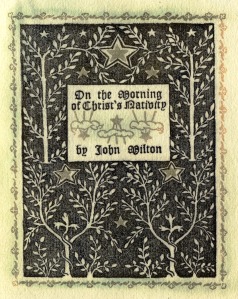
On the Morning of Christ’s Nativity by John Milton


An ode written by John Milton in 1629, one of his earliest poems, written when he was just 21, at
some time after Christmas. It contains a four-stanza proem (preamble – new word for me), and the main hymn of 27, 8-line stanzas. The hymn has four major themes:


Stanzas 1-12 – nature’s reaction to the advent of Christ.

I (excerpt)

It was the Winter wilde,

While the Heav'n-born-childe,

All meanly wrapt in the rude manger lies;

Nature in aw to him

Had doff't her gawdy trim,

With her great Master so to sympathize:


Stanzas: 13-18 anticipates Christ’s redemption of humanity.

XVI (excerpt)

The Babe lies yet in smiling Infancy,

That on the bitter cross

Must redeem our loss;

So both himself and us to glorifie:


Stanzas 19-26 depicting Christ’s expulsion or silencing of pagan dieties.

XIX (in entirety)

The Oracles are dumm,

No voice or hideous humm

Runs through the arched roof in words deceiving.

Apollo from his shrine

Can no more divine,

With hollow shreik the steep of Delphos leaving.

No nightly trance, or breathed spell,

Inspire's the pale-ey'd Priest from the prophetic cell.


The final stanza, 27 – the nativity scene itself.

XXVII (excerpt)

But see the Virgin blest,

Hath laid her Babe to rest.

Time is our tedious Song should here have ending,


It was beautiful, clearly a work of passion and devotion. I’ve not read Milton before, and this was an amazing introduction. I may take on Paradise Lost in the New Year.


The Early Modern English is a bit challenging. It was much more accessible with scholarly introduction and commentary, such as: The John Milton Reading Room


Merry Christmas


          ~ The Wanderer


May you be blessed with

the spirit of the season, which is Peace,

the gladness of the season, which is Hope, 

and the heart of the season, which is Love


.

Thursday, September 2, 2021

A Medicine for Melancholy and Other Stories by Ray Bradbury

Ray Bradbury is probably best known for his dystopian novel Fahrenheit 451 (the
one work cited on his tombstone). He was also a versatile short-story author, writing across numerous genres: horror, sci-fi, macabre, and realistic fiction. A Medicine for Melancholy is a collection of some of his short stories. 


I liked the fact that it had a sampling from all of the different genres, but I chose this collection primarily because it contained one story that has haunted me for half century. 


Sometime in my childhood, I read "All Summer in a Day", about adolescent Earth girl, Margot, whose family moved to Venus when she was very young, but not so young that she could not remember the warmth and sunshine of Earth. Margot’s Venus-born classmates dislike her and are incredulous of her Earth stories, because you see, on Venus it rains 24-7. On the day of the story however, there is a weather phenomenon that will result in a 2-hour period of clear skies and sunshine. Even as they prepare for the glorious summer in a day, the children continue to tease Margot, until their teasing escalates to a cruel prank. The rain stops, and they revel in the glorious summer. The rain returns, and...they remember Margot!


Oh, it is so beautifully heart breaking! The children could not, would not understand Margot because her experience was different than their own. And then, when they could know what Margot knew, their empathy came too late. 


Sigh! If only we could…


Medicine for melancholy indeed. The collection is worthwhile for this story alone, but it is filled with numerous gems. The cover depicts “The Wonderful Ice Cream Suit”, “A Medicine for Melancholy” is an individual short story, as well as the name of the collection. There is a macabre homage to Edgar Allan Poe’s The Cask of Amontillado called, “Pillar of Fire”. Bradbury is a grand story teller. His elegant prose, at times, feels more like poetry.


I highly recommend him for his novels and short stories.


.

Friday, December 11, 2020

Christmas Tales 2020

The Magi honored the Christ child with three gifts.


and in honor of the magi, I read three Christmas tales each December which are also my selections for A Literary Christmas hosted by In the Bookcase.


Christmas on Ganymede by Isaac Asimov


One of Jupiter’s moon, Ganymede has been, not so much colonized as industrialized, by Earth corporations which are harvesting the planet’s natural resources using the indigenous race of Ossies as labor (Ossies: so named for their resemblance to Ostriches) One of the earthmen, Olaf Johnson, innocently tells the Ossies of the Santa Claus legend, and the Ossies subsequently go on strike, until they are visited by Sannycaws. This will negatively impact the bottom line, so the corporate production supervisors, arrange for a reasonable facsimile, consisting of Olaf posing as Santa, a rudimentary flying sleigh, and another indigenous species, the spinyback – cross between an aardvark and stegosaurus – to perform as reindeer. It is intentionally, quite silly, and good clean fun, but not at all profound, as are my next two selections.


The Greatest Gift by Philip Van Doren Stern


This short story is the basis for the classic film, It’s a Wonderful Life. Legendary director Frank Capra called The Greatest Gift


…the story I had been looking for all my life!


To be honest, the film is the better telling, simply because it contains more details of how one life touches so many others. But the STORY, and its marvelous message, that THE greatest gift, the gift of life…is all Stern’s. In reviewing classic literature, I often say, skip the movie, read the book, but in this case I say, LOVE the movie, then appreciate it better, by reading the book. (Also read the background, of the short story Stern couldn’t sell, and how it became the classic film.)


The Haunted Man and the Ghost’s Bargain by Charles Dickens


This is final of Dickens’ five Christmas tales: A Christmas Carol, The Chimes, The Cricket on the Hearth, The Battle of Life, The Haunted Man and the Ghost's Bargain 


WOW!


Goodness, this surprised me. After Dickens drew raves for his first three Christmas novellas, he created great expectations (pardon the pun) for more, his fourth and fifth were not so well received, but for me, The Haunted Man and the Ghost’s Bargain is perhaps the most poignant of all. To further add to my enjoyment, it was a perfect complement to The Greatest Gift, as the moral for both could be…be careful what you wish for.


The haunted man is Mr. Redlaw, a man everyone would say


…looked like a haunted man.


He sits long hours alone, pondering over…


things that might have been, and never were


Redlaw is indeed haunted by a specter twin of himself, who reminds him of all the sorrow of his life, and who eventually offers him the dreadful bargain.


“Hear what I offer! Forget the sorrow, wrong, and trouble you have known! Forget them!” He repeated.


Redlaw is suspicious of the seemingly evil smile, that presages the bargain, but reasons to himself…


All men and women have their sorrows, - most of them their wrongs; ingratitude, and sordid jealousy, and interest besetting all degrees of life. Who would not forget their sorrows and their wrongs?


The bargain is struck, but course all does not turn out as was hoped (much like George Bailey’s bargain in The Greatest Gift.)


He is not happier, once relieved of the burdens of sorrowful memory, if anything, he is more miserable…and makes those around him more miserable in the bargain.


I am tempted to leave it at that, and tempt you to read it, but I cannot omit this moment, when Redlaw, in the depths of despair, is admonished by a kind and gentle friend.


“I have no learning, and you have much,” said Milly; “I am not used to think, and you are always thinking. May I tell you why it seems to me a good thing for us, to remember wrong that has been done us?”


“Yes.”


“That we may forgive it.”


Amen!


Merry Christmas


          ~ The Wanderer


May you be blessed with

the spirit of the season, which is Peace,

the gladness of the season, which is Hope, 

and the heart of the season, which is Love


.