Wednesday, December 22, 2021

Christmas Tales 2021

The Magi honored the Christ child with three gifts.


In honor of the magi, I read three Christmas tales each December. My Christmas reads are also part of A Literary Christmas – sponsored by In the Bookcase.


Papa Panov’s Special Christmas Day by Leo Tolstoy


A short story about Papa Panov, a village shoemaker somewhere in Imperial Russia. He seems a
simple man, in the best sense of the phrase, of modest means. He is a widower, and whatever children there were have long since left to make their own way. Papa Panov can still smile though at the sights and sounds of Christmas in his village. On Christmas Eve, he reads of the birth of Christ, and wishes he had been in Bethlehem to offer hospitality to Mary, Joseph, and the Son of God. He sleeps and dreams that Christ tells him he will visit Papa Panov on Christmas day.


Papa Panov awakes and awaits expectantly, but with a bit of doubt. It was only a dream after all. The only visitors are poor, and cold, and hungry. Papa Panov shares what he can to comfort the small stream of visitors. At days end as he prepares to retire for the night, he peacefully accepts…


it had been just a dream after all. Jesus had not come.


But there are a few lines left. They are not difficult to guess, but I’ll offer a hint from the Gospel of Matthew:


And the King shall answer and say unto them, Verily I say unto you, Inasmuch as ye have done it unto one of the least of these my brethren, ye have done it unto me. Matthew 25:40


A Christmas Inspiration by Lucy Maud Montgomery


A short story about a group of five young women – girls by most accounts – who, away from family in
a boarding house, share their Christmas treasures with one another in only slightly self-indulgent jollity. They remember the spinster, Miss Allen, whom they don’t really like, and who doesn’t really like them. They remember the postman, almost comical under his burden of gifts, and they remember that for Miss Allen there were no packages, no cards, no notice.


Jean, the unofficial leader of the group, has an inspiration, and the story turns foolishly maudlin, absurdly predictable, and blessedly beautiful!


The girls realize the “old truth, that it is more blessed to give than to receive. But this is so obvious, I would stand by my description of foolish and absurd, except the girls take the old truth and pledge to make it an “all-the-year-round inspiration.”
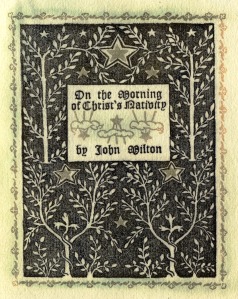


On the Morning of Christ’s Nativity by John Milton


An ode written by John Milton in 1629, one of his earliest poems, written when he was just 21, at
some time after Christmas. It contains a four-stanza proem (preamble – new word for me), and the main hymn of 27, 8-line stanzas. The hymn has four major themes:


Stanzas 1-12 – nature’s reaction to the advent of Christ.

I (excerpt)

It was the Winter wilde,

While the Heav'n-born-childe,

All meanly wrapt in the rude manger lies;

Nature in aw to him

Had doff't her gawdy trim,

With her great Master so to sympathize:


Stanzas: 13-18 anticipates Christ’s redemption of humanity.

XVI (excerpt)

The Babe lies yet in smiling Infancy,

That on the bitter cross

Must redeem our loss;

So both himself and us to glorifie:


Stanzas 19-26 depicting Christ’s expulsion or silencing of pagan dieties.

XIX (in entirety)

The Oracles are dumm,

No voice or hideous humm

Runs through the arched roof in words deceiving.

Apollo from his shrine

Can no more divine,

With hollow shreik the steep of Delphos leaving.

No nightly trance, or breathed spell,

Inspire's the pale-ey'd Priest from the prophetic cell.


The final stanza, 27 – the nativity scene itself.

XXVII (excerpt)

But see the Virgin blest,

Hath laid her Babe to rest.

Time is our tedious Song should here have ending,


It was beautiful, clearly a work of passion and devotion. I’ve not read Milton before, and this was an amazing introduction. I may take on Paradise Lost in the New Year.


The Early Modern English is a bit challenging. It was much more accessible with scholarly introduction and commentary, such as: The John Milton Reading Room


Merry Christmas


          ~ The Wanderer


May you be blessed with

the spirit of the season, which is Peace,

the gladness of the season, which is Hope, 

and the heart of the season, which is Love


.

Thursday, December 9, 2021

Wild at Heart Revised and Updated: Discovering the Secrets of a Man’s Soul by John Eldredge

…adventure is written into the heart of a man.


I read the wrong book.


I was looking for a book that I’d heard of that describes the natural development of manhood in six stages: boyhood, cowboy, warrior, lover, king, and sage. Someone told me they’d read that book and it was titled: Wild at Heart


Not quite. The book I was thinking of is called Fathered by God, which the author intends as a follow-up to Wild at Heart. I’ve started reading Fathered by God, and it isn’t essential to read Wild at Heart first, but since the author recommends it that way, my mistake was a happy accident.


Both books are along similar themes. WARNING – they are not politically correct, but I am more interested in what is simply correct (sans qualifier).


I would describe the theme something like: There are character traits that are distinctly male, and by implication, others that are distinctly female. That’s actually more of a premise rather than a theme. The theme then is to understand and nurture those masculine traits to the benefit of the man himself, his family, society, and to the service of God his creator.


And without apology, I concur. I won’t belabor the point here, or argue it. Read the book.


Eldredge asserts that every man is driven by three primal desires.


They may be misplaced, forgotten, or misdirected, but in the heart of every man is a desperate desire for a battle to fight, an adventure to live, and a beauty to love.


That definitely resonates with me.


Eldredge also states...


Man is not born into a sitcom or a soap opera; he is born into a world at war.


That intrigued me, and I had to think about it, but I believe it is true in both a physical and spiritual sense. I remembered something Eldredge said earlier in the book. Paraphrasing now – in the Bible picture of creation, the Garden of Eden is a pristine and peaceful setting. It is not immediately apparent, but the Universe was already at war, and has been ever since. Lucifer had rebelled, and along with his demon hordes wages spiritual warfare against God and his saints. In the physical realm, the  world has been at peace for less than 10 percent of recorded human history.


Setting the purpose for the warrior heart of man.


We need to heal the warrior heart in men, to be sure; set it in the service of goodness.


Amen!


And now I’m off to read Fathered by God, also by Eldredge.


.

Thursday, December 2, 2021

A Literary Christmas 2021

 brought to you by In the Bookcase


The Rules are simple – pick your Christmas reads for 2021, write a blog post about them, and link back to In the Bookcase.


I honor of the Magi, who brought the Christ child three gifts, I read three Christmas tales each December. This year I will be reading:


Papa Panov’s Special Christmas Day by Leo Tolstoy


On the Morning of Christ’s Nativity a poem by John Milton written in 1629.


A Christmas Inspiration by Lucy Maud Montgomery


Wrap Up post HERE


Have a Blessed Christmas


The Wanderer

Saturday, November 27, 2021

The Consequences of Ideas: Understanding the Concepts that Shaped Our World by R. C. Sproul

If there is no God, all things are permissible ~ Fyodor Dostoyevsky
 

Whenever the words “I think, therefore I am” by René Descartes come up, I tend to roll my eyes, and dismiss the obvious as pointless navel gazing.


No longer, thanks to theologian R. C. Sproul and this wonderfully accessible book, which he describes as a


…sketch of leading voices in the History of Western thought.


I am encouraged that a great mind like Sproul, also had a change of mind about philosophy


What I once ridiculed now absorbs me and carries me to the brink of holy apprehension, where I tremble at my own inadequacy.


His book is a look at the thinkers of Western history, from the first philosophers: Thales, Pythagoras, Heraclitus, Parmenides, Zeno, Empedocles, Anaxagoras; to the three pillars: Socrates, Plato, Aristotle; and those who followed: Augustine, Thomas Aquinas, René Descartes, John Locke, David Hume, Immanuel Kant, Karl Marx, Søren Kierkegaard, Friedrich Nietzsche, Jean-Paul Sartre, Charles Darwin, and Sigmund Freud. (not all philosophers, but all thinkers)


I cannot adequately review this book, and I am loathe to post excerpts, because most require pages of context to be rightly understood.


I will again state that is it quite accessible. I understand now that Descartes, was not navel-gazing. He quite logically concluded that before beginning an investigation of truth, he must have a building block – an indisputable, logical truth from which to start. Consequently, when starting with the undeniable “I think, therefore I am”, it led Descartes to: “I think, therefore God is”


Indeed, most of these thinkers came to logical conclusions of God, or the one whom Aristotle named the “unmoved mover”


Aristotle is chiefly responsible for two fundamental laws of logic:


The Law of noncontradiction – nothing can be what it is, and not be what it is at the same time and in the same relationship


The Law of causality – nothing can be its own cause


Most of the thinkers accepted these laws, and most concluded, like Aristotle, there MUST BE…an unmoved mover.


It should be obvious that not all these thinkers were Deists. Indeed Nietzsche declares himself the personal enemy of God. There is no doubt Sproul stands opposed to their views, but I felt he gave them fair trial by the Aristotelian laws of logic.


Sproul opines:


We live in perhaps the most anti-intellectual period of Christian history. We affirm technology and education, but we demean the role of the mind or intellect, particularly in the religious realm.


For me, this book was an indictment of modern thought, or in more positive terms, an admonishment to return to classical thought. We learn to do, but we are ignorant and untrained in how to think. Education is focused almost entirely on utility, ignoring virtue that Socrates asserts should be inseparable from knowledge.


In conclusion, Sproul writes:


We need to reconstruct the classical synthesis by which natural theology bridges the special revelation of Scripture and the general revelation of nature. Such a reconstruction could end the war between science and theology. The thinking person could embrace nature without embracing naturalism. All of life, in its unity and diversity could be lived coram Deo, before the face of God, under his authority and to his glory.


Attributes or quotations of some of the thinkers:


Whatever is; is ~ Parmenides


Socrates: The savior of Western Civilization. Asserted that knowledge and virtue are inseparable…


Plato: student of Socrates, mentor to Aristotle


Aristotle: posited the “unmoved mover”, that God is logically necessary.


Augustine: the greatest Christian philosopher-theologian of the first millennium, arguably of the entire Christian era. Achieved philosophical synthesis between Platonism and Christianity.


Thomas Aquinas: a giant in all the intellectual world. Produced a synthesis of Aristotelian philosophy and Christian theology, asserted that philosophy apart from the Bible, can rationally demonstrate God’s existence.


René Descartes: the father of modern philosophy, asserted “I think, therefore I am”


John Locke: The father of modern empiricism


To be is to be perceived ~ David Hume


Immanuel Kant: Theistic empiricist. Nothing could destroy his personal belief in God but he also believed that a knowledge of God cannot be demonstrated by “pure reason”


Søren Kierkegaard: Father of modern existentialism


Friedrich Nietzsche: Father of atheistic existentialism, asserted “God is Dead”


Jean-Paul Sartre – describes man as a “useless passion”. Declared he was not happy with his own conclusion that God does not exist.


Charles Darwin: Proponent of macroevolution


Sigmund Freud: Founder of psychoanalysis


.

Monday, November 22, 2021

The Cellist of Sarajevo by Steven Galloway (novel #192)

The cellist confuses her. She doesn’t know what he hopes to achieve with his playing. ~ narrative regarding Arrow


A beautiful, poignant, masterpiece.


The Cellist of Sarajevo is set during the siege of Sarajevo (April 1992 –

February 1996). The cellist refers to Vedran Smailović who played Albinoni’s Adagio, in the streets of Sarajevo for 22 days, in homage to 22 civilians who were killed while waiting in line to buy bread.


But the novel is fiction, and the cellist is never named, for the story is not truly about the cellist. It is about three souls, who like the cellist try to find normalcy in their desperate fight for survival.


Kenan is a family man, simply trying to keep his family alive. Kenan loves his city, and grieves for what it has become.


He knows that if he wants to be one of the people who rebuild the city, one of the people who have the right even to speak about how Sarajevo should repair itself, then he has to go outside and face the men on the hills. His family needs water, and he will get it for them.


Every fourth day or so, unless there is merciful rain, he must make a dangerous journey, within mortar range, and sniper range of the “men on the hills” simply to get water. When he closes the apartment door behind him, he pauses…


What he wants is to go back inside, crawl into bed, and sleep until this war is over. He wants to take his younger daughter to a carnival. He wants to sit up, anxious, waiting for his older daughter to return from a movie with a boy he doesn’t really like. He wants his son, the middle child, only ten years old, to think about anything other than how long it will be before he can join the army and fight.


Dragan is older, his wife and adult child, thank God, got out and are safe in Italy, but Dragan…


He doesn’t want to live under siege for the rest of this life, but to abandon the city to the men on the hills would mean that he would be forever homeless.


Before the tale is told, Dragan will risk his life to save a dead man.


All that matters is what he thinks. In the Sarajevo of his memory, it was completely unacceptable to have a dead man lying in the street. In the Sarajevo of today it’s normal.


And then there is Arrow who used to be someone else. She is only Arrow now, a weapon, a sniper – the best sniper – of the besieged forces within the city.


…she’s different from the snipers on the hills. She shoots only soldiers, they shoot unarmed men, women, children. When they kill a person, they seek a result that is far greater than the elimination of that individual. They are trying to kill the city.


When asked, she does not give her true name. She is not that person. She hopes she will be again one day.


She knows that in the city of her memory she wasn’t hungry, and she wasn’t bruised, and her shoulder didn’t bear the weight of a gun.


Arrow is sent by her commander to defend the cellist. They know an enemy sniper has been dispatched to kill the cellist. Arrow must stop him.


The cellist confuses her. She doesn’t know what he hopes to achieve with his playing. He can’t believe he will stop the war. He can’t believe he will save lives. Perhaps he has gone insane, but she doesn’t think so.


The fateful moment comes, she has the enemy sniper in her sights…


…she is, at once, sure of two things. The first is that she does not want to kill this man, and the second is that she must.


More would be a spoiler. It is powerful, poignant, bittersweet. It brought tears to my eyes.


My rating 4 ½ out of 5 stars


Other excerpts about the main characters


Kenan


What he wants is to go back inside, crawl into bed, and sleep until this war is over. He wants to take his younger daughter to a carnival. He wants to sit up, anxious, waiting for his older daughter to return from a movie with a boy he doesn’t really like. He wants his son, the middle child, only ten years old, to think about anything other than how long it will be before he can join the army and fight.


It isn’t clear to him how the world will think of the city now that thousands have been murdered. He suspects that what the world wants most is not to think of it at all.


They will rebuild the city without knowing whether this is the last time it will be done. They will earn the right to do this, any way they can, and when it is done, they’ll rest.


He knows that if he wants to be one of the people who rebuild the city, one of the people who have the right even to speak about how Sarajevo should repair itself, then he has to go outside and face the men on the hills. His family needs water, and he will get it for them.


Dragan


All that matters is what he thinks. In the Sarajevo of his memory, it was completely unacceptable to have a dead man lying in the street. In the Sarajevo of today it’s normal.


He doesn’t want to live under siege for the rest of this life, but to abandon the city to the men on the hills would mean that he would be forever homeless.


Arrow


It’s a rare gift to understand that your life is wondrous, and that it won’t last forever. ~ Arrow


She knows that in the city of her memory she wasn’t hungry, and she wasn’t bruised, and her shoulder didn’t bear the weight of a gun.

The cellist confuses her. She doesn’t know what he hopes to achieve with his playing. He can’t believe he will stop the war. He can’t believe he will save lives. Perhaps he has gone insane, but she doesn’t think so.


…she is, at once, sure of two things. The first is that she does not want to kill this man, and the second is that she must.


She kills them because she hates them. Does the fact that she has good reason to hate them absolve her?


My name is Alisa ~ (you may guess whose words these are)


I understand there is some drama in the personal life of the author. I am not informed enough to offer commentary. This review is only my opinion of this marvelous work of fiction.


.


Sunday, November 14, 2021

Ender’s Game by Orson Scott Card (novel #191)

And with that anger, he [Ender] decided he was strong enough to defeat them –
the teachers, his enemies.


Ender’s Game is a Sci-Fi fantasy set in Earth’s future. Ender is a child prodigy and at age six is in training, along with other gifted children, to assess their suitability to be Earth’s hero and the savior of the human race. 


Some decades earlier, Earth was attacked by a superior insect-like alien force, un-affectionately known as the Buggers. Humanity was on the verge of annihilation, when one pilot saved the world in a miraculous and bold maneuver.


The powers that be believe it is only a matter of time before a new and larger invasion force returns. They intend to pre-empt the attack, by bringing the fight to the Buggers. They also believe that children, with their aptitude for multi-tasking video games are humanity’s best hope. 


And in test after test, Ender rises to the top, as the best of the best. After he clears Battle School in record time, he is sent to Command School in deep space. Some of his fellow students are part of his command team. They practice and drill, and practice and drill against the computer simulation – the game – of Ender's Game.


But there is a dark and carefully guarded secret about the game, that neither Ender, his team, nor the reader can guess – until an amazing climax.


(I have to smugly boast that I caught on to the big reveal, a few paragraphs before Ender. It was staggering).


There is a slightly anti-climactic chapter, which is prologue to successive books in the Ender-Verse.


My rating 3 ½ out of 5 stars


This was a reread, but nearly as good the second time, and in some ways better when I knew the secret all along, though it lacked the same WOW! If you don’t like Sci-Fi, you might still like Ender’s Game. The human drama drives the plot more than the technology or aliens. I’ll read more in the Ender-Verse. Have you read Ender’s Game? What did you think.


My version: I have a leather bound Easton Press edition, signed by Orson Scott Card - a gift from my daughter.


Film rendition: The 2013 film with Asa Butterfield as Ender and Harrison Ford is decent, though it can hardly do it well in two hours. In the book, Ender’s training takes six years, but the child actors in the film don’t age, so it seems like all the training is done in a few months. But the biggest flaw in the film was the moment of the reveal about the game. They dumbed it down to make sure the audience got it, and it wasn’t as powerful.